
The Quick Facts: USDA organic food labels indicate agricultural products produced without synthetic pesticides, genetic engineering, or prohibited substances. Organic products must be certified by USDA-approved organic certifiers and meet specific organic requirements to display organic claims on their product labels.
Understanding organic food labeling helps shoppers make informed choices about their purchases. The United States Department of Agriculture (USDA) maintains strict organic standards for organic certification, overseeing the entire organic production process from farm to store shelf. These organic regulations cover everything from production methods to organic label requirements, giving consumers confidence in certified organic foods. This guide explores the four main organic label categories, certification requirements, and special considerations for different food types. By understanding these organic labeling guidelines, shoppers can better interpret organic claims and make purchasing decisions that align with their preferences.

USDA Organic Label Categories
“100 Percent Organic” Label Requirements
Products carrying the “100 Percent Organic” food label must contain only organically produced ingredients, excluding salt and water. This organic label applies mainly to raw, unprocessed agricultural products and minimally processed foods. For the principal display panel, manufacturers can use the USDA organic seal and the “100 percent organic” claim. The ingredient list must identify each organic ingredient, either with the word “organic” or with an asterisk that references organic ingredients.
“Organic” (95%+) Label Requirements
The organic food label indicates organic products containing at least 95% organic ingredients, not counting salt and water. The remaining 5% may include non-organic agricultural products or approved items from the National List. These non-organic components can only be used when organic versions aren’t commercially available. Like the 100% category, these products can display the USDA seal and use the organic claim on the main label. Each organic ingredient must be identified in the ingredient statement.
“Made with Organic” Category
Products in the “Made with Organic” category must contain at least 70% organic content, excluding salt and water. The principal display panel can state “made with organic” followed by up to three specific organic ingredients or food groups. These products face strict organic requirements – they cannot display the organic seal or represent the finished product as organic. While organic ingredients must be identified in the ingredient list, the remaining non-organic portion has specific constraints on allowed ingredients and organic production methods.
Label Placement and Design Rules for Organic Food Labels
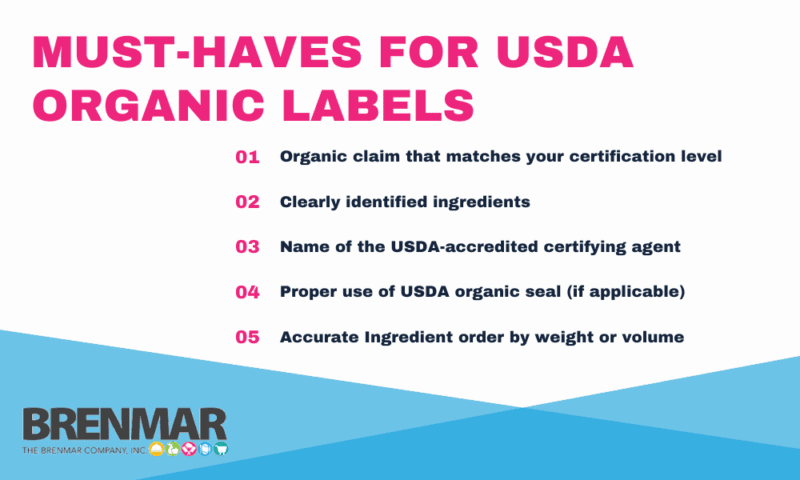
The Principal Display Panel (PDP) must follow strict organic regulations for organic products. This panel, which is the portion of the product label most likely seen by customers at purchase, has specific requirements based on the organic certification level. For organic food labels marked “100% Organic” or “Organic” (95%+ organic ingredients), the PDP may display the USDA organic seal and make organic claims. Products in the “Made with Organic” category (70-94% organic content) may state specific organic ingredients but cannot display the organic logo.
The Information Panel requirements include a detailed ingredient list where organic ingredients must be clearly identified, either by marking them as “organic” or using an asterisk that links to an organic designation. For organic food products with 70% or more organic content, the total percentage of organic ingredients must be displayed. The ingredient statement must present all components in descending order by weight or volume.
The USDA organic seal has precise usage rules for organic food labeling. The seal must maintain specific proportions and can be displayed in black, white, or in a green (Pantone 349) color scheme. The size must be large enough to be clearly visible but not dominate the packaging. A clear space must surround the organic logo, keeping it separate from other text or graphics. While the registration symbol (®) is permitted with the seal, it is not mandatory. Certified organic producers must get approval from their certifying agent before using the seal on any packaging.
Special Categories and Exceptions
Small Producer Exemptions
Small farmers and organic producers who sell less than $5,000 of organic products annually qualify for certification exemptions. While these operations don’t need formal organic certification, they must follow USDA organic production standards and maintain detailed records for 3 years. However, these exempt producers cannot use the USDA seal or supply organic ingredients to other manufacturers.
Special Product Categories
Alcoholic beverages face unique organic requirements:
- Must meet both USDA organic regulations and Alcohol and Tobacco Tax and Trade Bureau requirements
- Wine with added sulfites can only use “made with organic grapes” labeling
- All organic food labels need approval from both organic certifiers and the TTB
Multi-ingredient products follow specific organic content thresholds:
- “100% Organic”: Contains only organic ingredients
- “Organic”: Contains minimum 95% organic ingredients
- “Made with Organic”: Contains at least 70% organic ingredients
- Below 70%: Can only list specific organic ingredients on information panel
Imported organic food must come from countries with equivalent organic certification programs as determined by the United States. These organic products need documentation proving they meet U.S. organic standards.
Non-retail Containers
Bulk and shipping containers require:
- Clear identification of organic status
- Lot numbers for tracking
- Protection from contamination
- Prevention of contact with prohibited substances during transport
- Name of certifying agent when product displays organic seal

Understanding Organic Food Labels
Meeting organic labeling requirements demands careful attention to USDA organic regulations and specific organic standard categories. You can check to see if products from specific farms or businesses are USDA organic certified through the organic integrity database.
To implement proper organic food labels: First, determine your organic product’s category. Next, submit product labels for review by organic certifiers. Then, follow specific placement rules for the USDA seal and organic logo. Finally, maintain updated documentation of organic ingredients and processes.
Brenmar makes this process easier. We offer USDA-compliant organic labels that meet all federal standards for placement, size, and clarity—whether you need labels for “100% Organic,” and “Organic,” products. Our labeling solutions are trusted by certified producers across the country.
Need help navigating USDA requirements?
Shop Brenmar’s full line of pre-printed organic labels to stay compliant, save time, and present your products with professional quality. Contact us today to speak with a labeling expert or place your order.